

True competition is identical with true cooperation… Each player tries their hardest to defeat the other… Both grow stronger.
As it often happens in life, the most important thing is not about doing more, but to hinder yourself less and remove all obstacles you created yourself on your own way to win a game. The Inner Game of Tennis by Timothy Gallwey gives us insightful ideas to act naturally, accurately and effortlessly — on the court or in life. Here are several key principles from the book we can use right now, but first of all let me introduce the concept of two selves.
The article is fully based on quotations from the book, without my distracting comments, so you can enjoy the original ideas. I highly recommend you to read this book.[/vc_column_text]
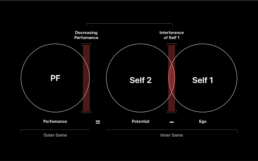
Two Selves
Who was talking to whom? Who was scolding, and who being scolded? “I’m talking to myself,” say most people. But just who is this, “I” and who the “myself”?
Now we are ready for the first major postulate of the Inner Game: Within each player the kind of relationship that exists between Self 1 and Self 2 is the prime factor in determining one’s ability to translate knowledge of technique into effective action. In other words, the key to better tennis, or better anything, lies in improving the relationship between the conscious teller, Self 1, and the natural capabilities (aka potential) of Self 2.
Succeeding comes from trust, not control
Self 1 is always busy telling Self 2 what to do. It doesn’t trust Self 2 to do anything right on its own.
Harmony between the two selves exists when Self 1 is quiet and focused. Only then can peak performance be reached. In short, getting Self 1 and Self 2 together requires slowing the mind, quieting the mind means less thinking, calculating, judging, worrying, fearing, hoping, trying, regretting, controlling. The mind is still when it is totally here and now in perfect oneness with the action and the actor. It is the purpose of the Inner Game to increase the frequency and the duration of these moments, quieting the mind by degrees and realizing thereby a continual expansion of our capacity to learn and perform.
Nonjudgmental awareness
Ending judgment means you neither add nor subtract from the facts before your eyes. Things appear as they are — undistorted.
When we judge an event as “good” or “bad”, we complicate the process. If we just perceive things as they are, our brain will correct our actions to get it the way we want to be. Judgement slows down the learning process. Awareness and observation speeds up.
One balancing thought. It is important to remember that not all remarks are judgmental. Acknowledgment of one’s own or another’s strengths, efforts, accomplishments, etc., can facilitate natural learning, whereas judgments interfere. What is the difference? Acknowledgment of and respect for one’s capabilities support trust in Self 2. Self 1’s judgments, on the other hand, attempt to manipulate and undermine that trust.
Focus is born from curiosity, not efforts
Natural focus occurs when the mind is interested… It is effortless and relaxed, not tense and overly controlled.
So the question arises as to how to maintain focus for extended periods of time. The best way is to allow yourself to get interested in the ball. How do you do this? By not thinking you already know all about it, no matter how many thousands of balls you have seen in your life. Not assuming you already know is a powerful principle of focus.
Focus is not achieved by staring hard at something. It is not trying to force focus, nor does it mean thinking hard about something. Natural focus occurs when the mind is interested. When this occurs, the mind is drawn irresistibly toward the object (or subject) of interest. It is effortless and relaxed, not tense and overly controlled.
Positive thinking creates expectations
My compliments are criticisms in disguise. I use both to manipulate behavior… Self 1 sees a compliment as a potential criticism.
Clearly, positive and negative evaluations are relative to each other. It is impossible to judge one event as positive without seeing other events as not positive or as negative. There is no way to stop just the negative side of the judgmental process. To see your strokes as they are, there is no need to attribute goodness or badness to them.
“But,” protests Self 1, “if I see my ball going out and I don’t evaluate it as bad, I won’t have any incentive to change it. If I don’t dislike what I’m doing wrong, how am I going to change it?” Self 1, the ego-mind, wants to take responsibility for making things “better.” It wants the credit for playing an important role in things. It also worries and suffers a lot when things don’t go its way.
Winning is not a matter of score, but of effort
The difference between being concerned about winning and being concerned about making the effort to win may seem subtle, but in the effect there is a great difference.
When love and respect depend on winning, and in a competitive society it is inevitable (since every winner requires a loser and every top performance requires inferior ones), there will be many people who feel a lack of love and respect. Of course, these people will try hard to win the respect they lack, and the winners will try equally hard not to lose the respect they have won. In this light, it is not difficult to see why playing well has come to mean so much to us.
But who said that I am to be measured by how well I do things? In fact, who said that I should be measured at all?
Who indeed? What is required to disengage oneself from this trap is a clear knowledge that the value of a human being cannot be measured by performance — or by any other arbitrary measurement. Do we really think the value of a human being is measurable? It doesn’t really make sense to measure ourselves in comparison with other measurable beings. In fact, we are what we are, we are not how well we happen to perform at a given moment. The grade on a report card may measure an ability in arithmetic, but it doesn’t measure the person’s value. Similarly, the score of a tennis match may be an indication of how well I performed or how hard I tried, but it does not define me, nor give me cause to consider myself as something more or less than I was before the match.
Rival isn’t our enemy, it’s our partner
True competition is identical with true cooperation… Each player tries their hardest to defeat the other… Both grow stronger.
Once one recognizes the value of having difficult obstacles to overcome, it is a simple matter to see the true benefit that can be gained from competitive sports. In tennis, who is it that provides the player with the obstacles they need in order to experience their highest limits? The opponent, of course! Then is your opponent a friend or an enemy? They are friends to the extent that they do their best to make things difficult for you. Only by playing the role of your enemy do they become your true friend. Only by competing with you do they in fact cooperate!
In this use of competition it is the duty of your opponent to create the greatest possible difficulties for you, just as it is yours to try to create obstacles for them. Only by doing this do you give each other the opportunity to find out to what heights each can rise. Сompetition and cooperation become one.
You aren’t what you achieve
We are not how well we happen to perform at a given moment.
If I am secretly afraid that playing badly or losing the match may be taken to mean that I am less of a man, naturally I am going to be more upset with myself for missing shots. And, of course, this very uptightness will make it more difficult for me to perform at my highest levels. There would be no problem with competition if one’s self-image were not at stake.
I have taught many children and teenagers who were caught up in the belief that their self-worth depended on how well they performed at tennis and other skills. Many parents foster this belief in their children. Yet in the process of learning to measure our value according to our abilities and achievements, the true and measureless value of each individual is ignored. Children who have been taught to measure themselves in this way often become adults driven by a compulsion to succeed which overshadows all else. The tragedy of this belief is not that they will fail to find the success they seek, but that they will not discover the love or even the self-respect they were led to believe will come with it.
What does it mean to win the Inner Game
A few years ago, I might have tried to answer this question. Now I choose not to — even though I think it is the most important question. Any attempt to define an answer to this question is an invitation to Self 1 to form a misconception. Self 1, in fact, has come a long way if it has gotten to the point where it can admit, and mean it, that it doesn’t know and never will.
As it often happens in life, the most important thing is not about doing more, but to hinder yourself less and remove all obstacles you created yourself on your own way to win a game. The Inner Game of Tennis by Timothy Gallwey gives us insightful ideas to act naturally, accurately and effortlessly — on the court or in life. Here are several key principles from the book we can use right now, but first of all let me introduce the concept of two selves.
The article is fully based on quotations from the book, without my distracting comments, so you can enjoy the original ideas. I highly recommend you to read this book.[/vc_column_text]
Two Selves
Who was talking to whom? Who was scolding, and who being scolded? “I’m talking to myself,” say most people. But just who is this, “I” and who the “myself”?
Now we are ready for the first major postulate of the Inner Game: Within each player the kind of relationship that exists between Self 1 and Self 2 is the prime factor in determining one’s ability to translate knowledge of technique into effective action. In other words, the key to better tennis, or better anything, lies in improving the relationship between the conscious teller, Self 1, and the natural capabilities (aka potential) of Self 2.
Succeeding comes from trust, not control
Self 1 is always busy telling Self 2 what to do. It doesn’t trust Self 2 to do anything right on its own.
Harmony between the two selves exists when Self 1 is quiet and focused. Only then can peak performance be reached. In short, getting Self 1 and Self 2 together requires slowing the mind, quieting the mind means less thinking, calculating, judging, worrying, fearing, hoping, trying, regretting, controlling. The mind is still when it is totally here and now in perfect oneness with the action and the actor. It is the purpose of the Inner Game to increase the frequency and the duration of these moments, quieting the mind by degrees and realizing thereby a continual expansion of our capacity to learn and perform.
Nonjudgmental awareness
Ending judgment means you neither add nor subtract from the facts before your eyes. Things appear as they are — undistorted.
When we judge an event as “good” or “bad”, we complicate the process. If we just perceive things as they are, our brain will correct our actions to get it the way we want to be. Judgement slows down the learning process. Awareness and observation speeds up.
One balancing thought. It is important to remember that not all remarks are judgmental. Acknowledgment of one’s own or another’s strengths, efforts, accomplishments, etc., can facilitate natural learning, whereas judgments interfere. What is the difference? Acknowledgment of and respect for one’s capabilities support trust in Self 2. Self 1’s judgments, on the other hand, attempt to manipulate and undermine that trust.
Focus is born from curiosity, not efforts
Natural focus occurs when the mind is interested… It is effortless and relaxed, not tense and overly controlled.
So the question arises as to how to maintain focus for extended periods of time. The best way is to allow yourself to get interested in the ball. How do you do this? By not thinking you already know all about it, no matter how many thousands of balls you have seen in your life. Not assuming you already know is a powerful principle of focus.
Focus is not achieved by staring hard at something. It is not trying to force focus, nor does it mean thinking hard about something. Natural focus occurs when the mind is interested. When this occurs, the mind is drawn irresistibly toward the object (or subject) of interest. It is effortless and relaxed, not tense and overly controlled.
Positive thinking creates expectations
My compliments are criticisms in disguise. I use both to manipulate behavior… Self 1 sees a compliment as a potential criticism.
Clearly, positive and negative evaluations are relative to each other. It is impossible to judge one event as positive without seeing other events as not positive or as negative. There is no way to stop just the negative side of the judgmental process. To see your strokes as they are, there is no need to attribute goodness or badness to them.
“But,” protests Self 1, “if I see my ball going out and I don’t evaluate it as bad, I won’t have any incentive to change it. If I don’t dislike what I’m doing wrong, how am I going to change it?” Self 1, the ego-mind, wants to take responsibility for making things “better.” It wants the credit for playing an important role in things. It also worries and suffers a lot when things don’t go its way.
Winning is not a matter of score, but of effort
The difference between being concerned about winning and being concerned about making the effort to win may seem subtle, but in the effect there is a great difference.
When love and respect depend on winning, and in a competitive society it is inevitable (since every winner requires a loser and every top performance requires inferior ones), there will be many people who feel a lack of love and respect. Of course, these people will try hard to win the respect they lack, and the winners will try equally hard not to lose the respect they have won. In this light, it is not difficult to see why playing well has come to mean so much to us.
But who said that I am to be measured by how well I do things? In fact, who said that I should be measured at all?
Who indeed? What is required to disengage oneself from this trap is a clear knowledge that the value of a human being cannot be measured by performance — or by any other arbitrary measurement. Do we really think the value of a human being is measurable? It doesn’t really make sense to measure ourselves in comparison with other measurable beings. In fact, we are what we are, we are not how well we happen to perform at a given moment. The grade on a report card may measure an ability in arithmetic, but it doesn’t measure the person’s value. Similarly, the score of a tennis match may be an indication of how well I performed or how hard I tried, but it does not define me, nor give me cause to consider myself as something more or less than I was before the match.
Rival isn’t our enemy, it’s our partner
True competition is identical with true cooperation… Each player tries their hardest to defeat the other… Both grow stronger.
Once one recognizes the value of having difficult obstacles to overcome, it is a simple matter to see the true benefit that can be gained from competitive sports. In tennis, who is it that provides the player with the obstacles they need in order to experience their highest limits? The opponent, of course! Then is your opponent a friend or an enemy? They are friends to the extent that they do their best to make things difficult for you. Only by playing the role of your enemy do they become your true friend. Only by competing with you do they in fact cooperate!
In this use of competition it is the duty of your opponent to create the greatest possible difficulties for you, just as it is yours to try to create obstacles for them. Only by doing this do you give each other the opportunity to find out to what heights each can rise. Сompetition and cooperation become one.
You aren’t what you achieve
We are not how well we happen to perform at a given moment.
If I am secretly afraid that playing badly or losing the match may be taken to mean that I am less of a man, naturally I am going to be more upset with myself for missing shots. And, of course, this very uptightness will make it more difficult for me to perform at my highest levels. There would be no problem with competition if one’s self-image were not at stake.
I have taught many children and teenagers who were caught up in the belief that their self-worth depended on how well they performed at tennis and other skills. Many parents foster this belief in their children. Yet in the process of learning to measure our value according to our abilities and achievements, the true and measureless value of each individual is ignored. Children who have been taught to measure themselves in this way often become adults driven by a compulsion to succeed which overshadows all else. The tragedy of this belief is not that they will fail to find the success they seek, but that they will not discover the love or even the self-respect they were led to believe will come with it.
What does it mean to win the Inner Game
A few years ago, I might have tried to answer this question. Now I choose not to — even though I think it is the most important question. Any attempt to define an answer to this question is an invitation to Self 1 to form a misconception. Self 1, in fact, has come a long way if it has gotten to the point where it can admit, and mean it, that it doesn’t know and never will.
You might also like